Home Gardening Set: Fresh Vector Illustrations for Creators
There’s a specific kind of energy that comes from working with plants—whether you’re repotting a succulent on a sunny windowsill or sketching out a new layout for a backyard vegetable patch. For designers, marketers, and content creators, capturing that organic, hands-on feeling can be a challenge. You need assets that feel authentic, not staged. That’s exactly where a robust Home Gardening Set steps in. This isn't just a random assortment of greenery; it's a comprehensive collection of vector illustrations designed to bring the warmth of horticulture into your digital and print projects.
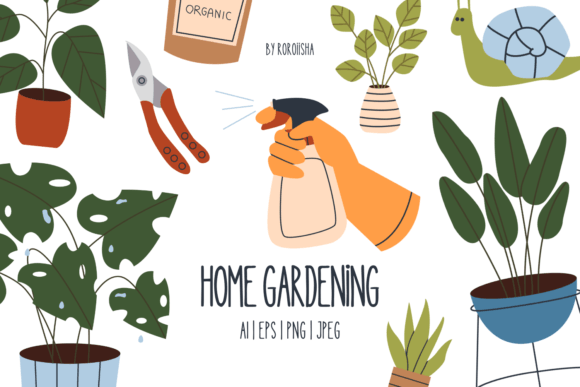
At its core, this set is built around the concept of "doing." It moves beyond static images of plants sitting on shelves. Instead, you’ll find various hands watering and planting, capturing the tactile connection between people and nature. The visual style is distinctly colored flat vector illustration. This aesthetic is currently dominating modern web design and social media graphics because it is clean, scalable, and friendly without being childish. The lines are confident but organic, avoiding the sterile perfection of geometric vectors in favor of something that feels more approachable and human.
The Anatomy of the Collection
When you unpack this design asset, the versatility is immediately apparent. The archive is structured to give you maximum flexibility. You receive a vector file in both AI and EPS formats, which is crucial for any professional application. If you need to change the color of a terracotta pot to match a client’s brand identity or scale a watering can up for a billboard without losing resolution, the vector source files make this effortless.
However, the utility goes further. The set includes 13 individual elements provided in PNG and JPEG formats. This is a massive time-saver for those who aren't fluent in Illustrator or simply need to drag-and-drop assets into a presentation or blog post. Imagine you are a publisher working on a spring newsletter. You don't have time to deconstruct a vector file; you just need a transparent PNG of a hand planting a seed to drop into your header image. This set anticipates that workflow.
The visual inventory covers the full spectrum of the gardening experience. You have your flower pots and garden tools—the spades, trowels, and rakes that ground the imagery in reality. But the character comes from the flora and the action. The plants range from leafy houseplants to blooming flowers, offering a palette that feels vibrant but grounded. The color theory in these illustrations tends to lean into earth tones mixed with botanical greens and soft accent colors, making them easy to integrate into almost any layout without clashing with existing typography or background colors.
Integrating Flat Illustrations into Modern Design
As a designer or entrepreneur, you are likely navigating a visual landscape that is tired of stock photography. Consumers are increasingly savvy; they can spot a generic stock photo of a "businessman holding a plant" from a mile away, and it often damages credibility. Flat vector illustrations, like those found in this Home Gardening Set, solve this by offering a stylized reality. They communicate an idea—growth, care, nature, sustainability—without the baggage of specific photographic models or lighting conditions.
Consider the application in packaging design. If you are launching an organic tea brand or a line of natural soaps, the aesthetic of these illustrations aligns perfectly with the product. The flat style scales beautifully onto labels and boxes, maintaining crisp edges whether printed on a small lip balm tube or a large shipping box. Because the style is consistent across the set, you can mix and match elements—perhaps using a tool illustration for the "how-to" section of your packaging and the watering hands for the "care instructions"—to create a cohesive visual narrative.
For digital assets, the application is equally powerful. In UI/UX design, empty states (the screen a user sees when they have no data, like an empty shopping cart or a blank to-do list) are often missed opportunities. Using a friendly illustration of a plant waiting to grow can soften the user experience. It turns a negative moment (nothing is here yet) into a potential one (something will grow here). This psychological nudge is subtle but effective in user engagement.
Practical Application for Content Creators and Marketers
For bloggers and content creators, the challenge is often consistency. You need a visual language that readers recognize instantly across your website, Pinterest pins, and Instagram stories. The Home Gardening Set acts as a foundational library for this. Because the illustrations share a common line weight and color palette, they function as a system rather than isolated images.
Let’s look at a practical scenario for a small business owner running a local nursery or a landscaping service. You need to update your social media, but you don't have the budget for a photographer every week. You can use these vector elements to create templates. You might overlay a text box on a JPEG background of garden tools for a "Tip Tuesday" post. Or, you could use the PNG elements of the hands planting to create a step-by-step guide graphic in Canva. The visual consistency makes your feed look curated and professional, building brand recognition over time.
Furthermore, these assets are invaluable for editorial design. If you are designing an eBook about sustainability or a PDF guide for "Indoor Gardening for Beginners," spot illustrations are essential for breaking up long blocks of text. A small vector of a watering can at the end of a chapter or a decorative border of leaves can significantly improve the reader's experience, making the content feel less dense and more enjoyable to consume.
Why the "Flat" Style Remains King
It is worth noting why the colored flat vector style is such a safe and strategic bet for your projects. In the world of modern typography and graphic design, trends come and go—3D text, gradients, glassmorphism—but flat illustration remains a staple. It is the "sans serif" of the illustration world: clean, versatile, and legible.
When you pair these illustrations with a premium font—whether it’s a bold serif font for a magazine header or a clean sans serif font for body copy—the flat style ensures the visuals don't compete with the text. If you used hyper-realistic 3D renders, they might overshadow your typography. The flat style in this set acts as a supporting player, enhancing the message rather than stealing the spotlight.
Additionally, the scalability of vectors is a non-negotiable requirement for professional work. A display font needs to look good at 72pt, just as a script font needs to be legible at 12pt. Similarly, your illustrations need to work on a favicon (16x16 pixels) and a hero banner. The EPS and AI files included in this set ensure that the design assets remain sharp, regardless of the resolution.
Final Thoughts on Utility
Ultimately, the value of a Home Gardening Set lies in its ability to convey a specific lifestyle and set of values—growth, patience, care, and nature—through visual shorthand. Whether you are a crafter designing a tote bag, a marketer building a campaign for an eco-friendly product, or a hobbyist sprucing up a personal blog, these illustrations provide a high-quality, versatile foundation.
By combining the action-oriented imagery of hands at work with the clean aesthetic of flat design, this collection bridges the gap between artistic expression and practical utility. It’s not just about making things look pretty; it’s about communicating effectively with a visual language that resonates with a modern audience.